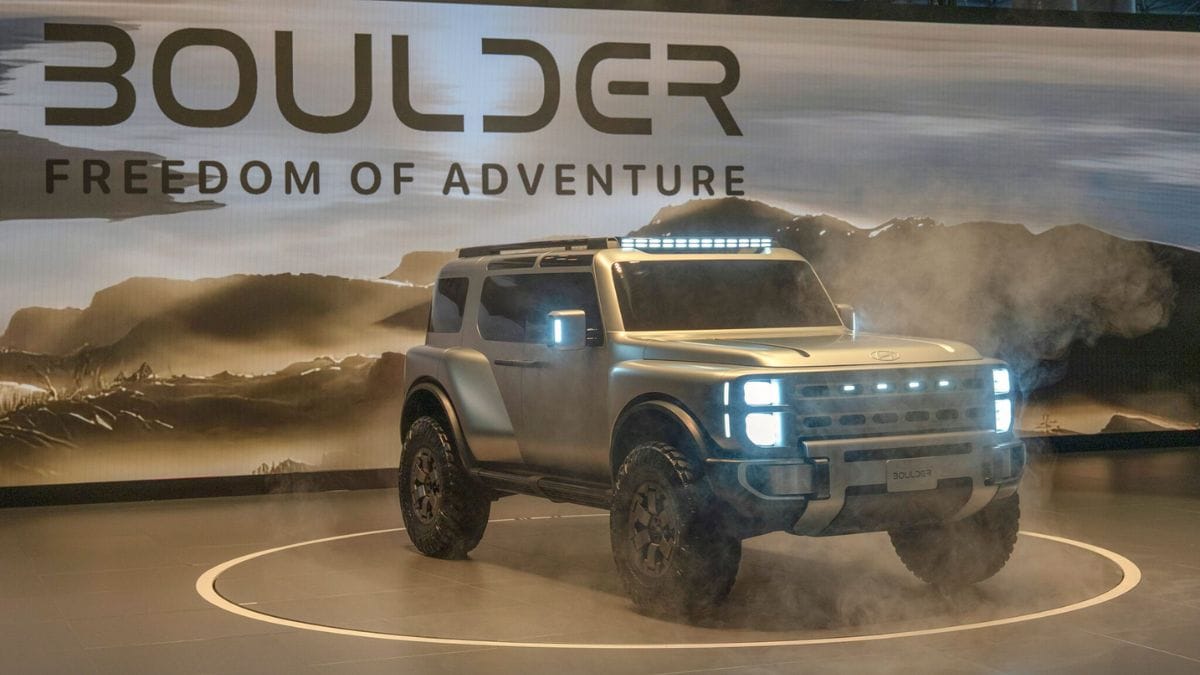
The Hyundai Boulder Concept stands apart from the brand’s current design and engineering direction. It is not merely a styling experiment, but a deeper indication of what Hyundai could be exploring for the future. Beneath its rugged, Ford Bronco-inspired exterior lies a significant development – Hyundai’s first fully boxed body-on-frame platform.
This detail is particularly relevant for markets like India, where traditional ladder-frame SUVs continue to hold strong aspirational value. While the Boulder is still a concept, it raises a broader question about whether Hyundai could eventually enter this segment with a more utility-focused product.
Concept
The Boulder Concept reflects a shift in thinking for Hyundai. Known largely for its monocoque-based SUVs, the company has focused on comfort, refinement, and urban usability. The Boulder, however, represents a move toward durability and off-road capability.
A body-on-frame platform is typically associated with vehicles designed for tougher conditions. It offers better load-bearing capacity and improved off-road resilience compared to monocoque structures. By developing such a platform, Hyundai appears to be testing the waters in a space it has not traditionally occupied.

The design itself reinforces this intent. With a boxy stance and upright proportions, the Boulder signals a more functional and purpose-driven approach rather than purely aesthetic appeal.
India
Hyundai’s current SUV lineup in India is built around monocoque platforms. Models like the Creta, Alcazar, and Tucson focus on ride comfort, feature-rich interiors, and efficient packaging.
This strategy has proven successful. The Creta consistently leads its segment, while the Alcazar and Tucson cater to more premium buyers. However, these vehicles are not designed for serious off-road use.
As a result, Hyundai does not currently have a presence in the body-on-frame SUV category in India. This segment, although smaller in volume, carries significant brand value and customer aspiration.

Segment
The ladder-frame SUV segment in India includes models that are often associated with strength, durability, and status. Vehicles like the Toyota Fortuner and Land Rover Defender are clear examples.
These SUVs are not always chosen for their practicality or efficiency. Instead, they appeal to buyers looking for a strong road presence and the ability to handle challenging terrains.
Here is a brief comparison of positioning:
| Segment Type | Examples | Key Focus |
|---|---|---|
| Monocoque SUVs | Creta, Tucson | Comfort, efficiency |
| Ladder-frame SUVs | Fortuner, Defender | Strength, off-road ability |
Hyundai’s absence in the second category highlights a gap in its portfolio, especially in a market where such vehicles contribute to brand perception.

Potential
The Boulder Concept suggests that Hyundai may be considering a broader SUV strategy. While there is no confirmation of a production model, the development of a body-on-frame platform is a notable step.
If Hyundai chooses to build on this concept, it could eventually introduce a rugged SUV tailored for markets like India. Such a move would allow the brand to expand beyond urban crossovers and enter the lifestyle and utility-focused segment.
However, this would require careful positioning. Pricing, capability, and brand perception would all play a critical role in determining success.
Strategy
Hyundai’s approach in India has so far been consistent and effective. By focusing on monocoque SUVs, the company has addressed the needs of a wide customer base.
Entering the ladder-frame segment would represent a strategic shift rather than a simple expansion. It would involve competing with established players that already have strong brand recognition in this space.
At the same time, the growing interest in adventure-oriented vehicles and lifestyle SUVs could create new opportunities. A product inspired by the Boulder Concept could help Hyundai tap into this demand.
Outlook
At present, the Boulder remains a global concept and is not part of Hyundai India’s immediate plans. It would be premature to expect a direct competitor to models like the Jeep Wrangler or Toyota Fortuner in the near term.
However, the concept opens up an important discussion about Hyundai’s future direction. It indicates that the company is exploring new architectures and possibly new segments.
For India, this could mean a more diverse SUV portfolio in the long run. Whether or not the Boulder itself reaches production, the ideas behind it may influence future models.
The Hyundai Boulder Concept highlights a potential evolution in the brand’s SUV strategy. While it remains a concept for now, its underlying platform and design direction suggest new possibilities. For a market like India, where rugged SUVs continue to hold strong appeal, such developments are worth watching closely.
FAQs
What is Hyundai Boulder Concept?
It is a rugged SUV concept with body-on-frame design.
Does Hyundai sell ladder-frame SUVs in India?
No, it currently offers only monocoque SUVs.
What platform does Boulder use?
A fully boxed body-on-frame platform.
Is Boulder coming to India?
There is no official confirmation yet.
Which SUVs compete in this segment?
Fortuner and Defender are key examples.