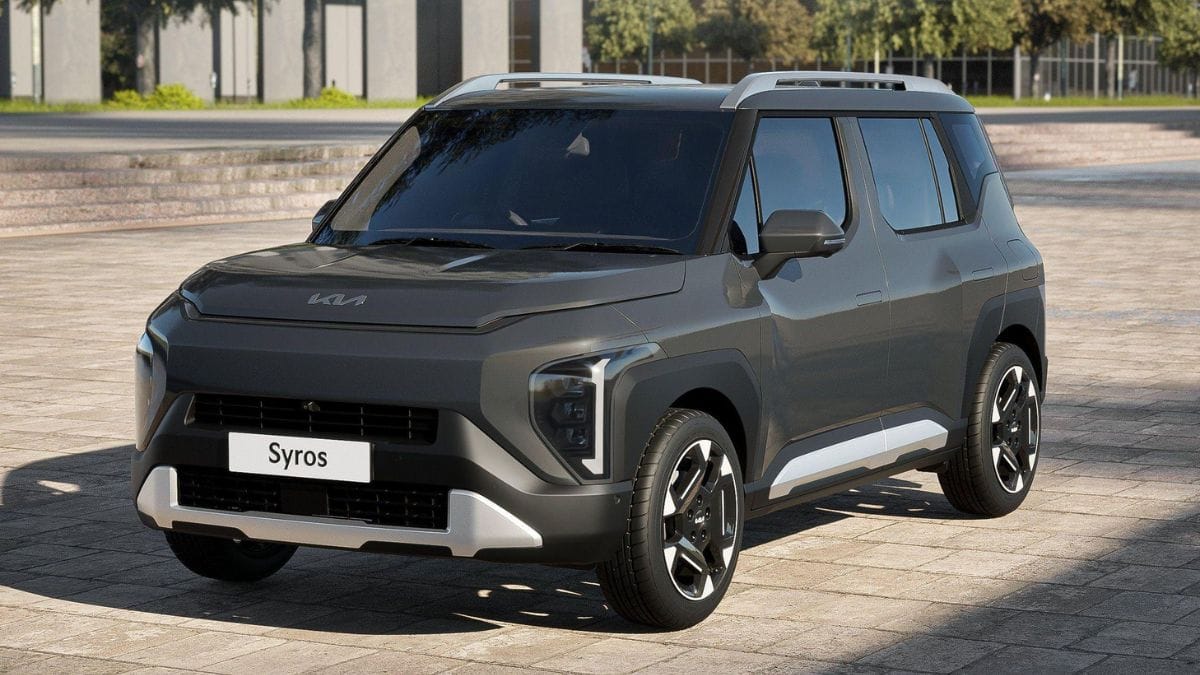
Kia is preparing to expand its electric vehicle portfolio in India with the debut of the Syros EV, scheduled for July 2026. The announcement was made as part of the company’s investor presentation, confirming that this will be Kia’s second locally manufactured electric vehicle in the country.
With this addition, Kia’s total EV lineup for India is expected to grow to four models, indicating a steady push toward electrification in one of its key markets.
The Syros EV is expected to be based on the internal combustion engine version of the Syros, which is already available in the market. Early sightings and test mules suggest that the electric version will retain much of the same design and structure.
Here is a quick overview of what to expect:
| Particulars | Details |
|---|---|
| Model | Kia Syros EV |
| Debut Timeline | July 2026 |
| Production | Locally manufactured |
| Segment | Sub-compact SUV |
| Expected Battery | 42kWh |
| Expected Power Output | 133bhp |
| Expected Torque | 255Nm |
This positions the Syros EV as a practical urban electric SUV with a focus on efficiency and usability.
Design
Based on spy images and industry expectations, the Syros EV is likely to closely resemble its ICE counterpart. The overall silhouette, dimensions, and interior layout are expected to remain largely unchanged.
The key differences may include:
- A closed-off front grille typical of EVs
- Redesigned alloy wheels for improved aerodynamics
- EV-specific badging
This approach allows manufacturers to reduce development costs while maintaining brand familiarity for customers.

Interior
The current Syros is known for offering a spacious cabin relative to its segment, along with a feature-rich setup. The EV version is expected to carry forward these strengths.
Buyers can expect:
- A spacious cabin layout
- Modern infotainment system
- Connected car features
- Practical storage spaces
Kia has typically focused on offering well-equipped interiors, and the Syros EV is likely to follow that pattern.
Powertrain
The Syros EV is expected to use a 42kWh battery pack paired with an electric motor producing around 133bhp and 255Nm of torque.

While official range figures have not yet been disclosed, this configuration suggests a balance between performance and efficiency, suitable for daily urban and semi-urban usage.
The expected specifications indicate:
- Smooth acceleration typical of electric vehicles
- Adequate power for city and highway driving
- Competitive positioning within its segment
Platform
Reports suggest that the Syros EV may share its underpinnings with the upcoming Carens EV. This shared architecture approach allows Kia to streamline production and optimize costs.
Platform sharing also typically ensures:
- Proven reliability
- Faster development cycles
- Consistent performance standards
This could play a role in making the Syros EV more competitive in pricing and features.
Competition
The sub-compact electric SUV segment in India is gradually gaining traction. While earlier expectations suggested slower growth, the segment is now seeing increased activity.
By early 2027, the Syros EV is expected to compete with:
- Tata Nexon EV
- Mahindra XUV 3XO EV
Here is a brief comparison of the emerging segment:
| Model | Segment Position | Status |
|---|---|---|
| Tata Nexon EV | Established | On sale |
| Mahindra XUV 3XO EV | Upcoming | Expected |
| Kia Syros EV | Upcoming | Debut July 2026 |
Although the segment is still developing, it presents an opportunity for automakers to establish early leadership.
Market
Kia’s decision to introduce another locally produced EV reflects its long-term strategy for India. Local manufacturing can help reduce costs and improve accessibility.
The Syros, in its ICE form, has not achieved strong sales numbers so far. The EV version could help reposition the model in a growing and relatively less crowded segment.
Factors that may influence its success include:
- Competitive pricing
- Feature-rich offering
- Brand value and after-sales network
If positioned correctly, the Syros EV could attract buyers looking to transition to electric mobility without moving to larger or more expensive vehicles.
Positioning
The Syros EV is expected to sit in a relatively new and evolving segment. Unlike traditional compact SUVs, electric models in this category are still limited in number.
This creates a scenario where:
- Early entrants can build strong market presence
- Buyers have fewer options, increasing visibility
- Feature differentiation becomes important
Kia’s strategy appears to focus on offering a balanced package rather than a niche product.
Outlook
The upcoming debut of the Kia Syros EV marks another step in the gradual expansion of electric mobility in India. With expected competitive specifications, familiar design, and local production, the model is positioned to appeal to a wide range of buyers.
However, its success will depend on pricing, real-world range, and how well it differentiates itself from existing and upcoming rivals. As the segment continues to evolve, the Syros EV could play a role in shaping buyer preferences in the sub-compact electric SUV category.
FAQs
When will Kia Syros EV launch?
It will debut in July 2026.
What battery will it use?
It may get a 42kWh battery pack.
Is it locally manufactured?
Yes, it will be made in India.
What are expected rivals?
Nexon EV and XUV 3XO EV.
What power output is expected?
Around 133bhp and 255Nm.