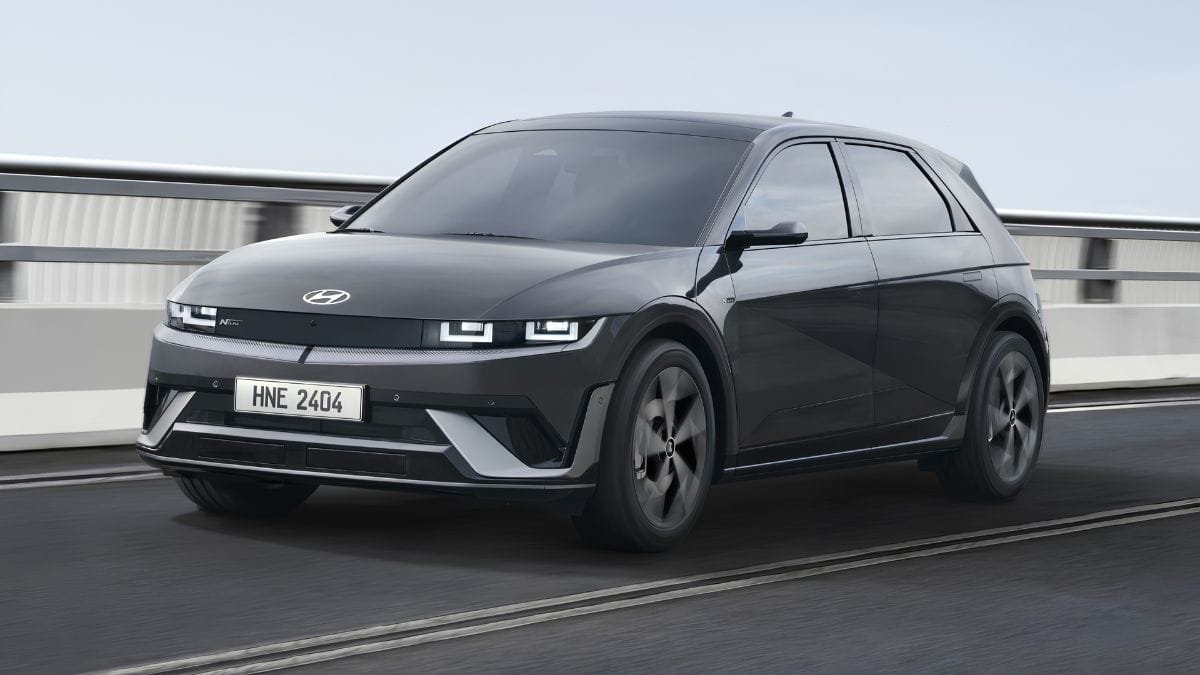

The Hyundai Ioniq 5 has been one of the more notable electric vehicles in India’s premium EV segment, known for its distinct design and fast-charging capability.
The upcoming facelift aims to build on that foundation with measured improvements rather than a complete redesign. With updates to the powertrain, battery capacity, and in-car technology, Hyundai appears to be addressing key areas that matter to everyday users.
Design
The exterior design of the facelifted Ioniq 5 remains largely consistent with the current model. Hyundai has chosen to retain the overall silhouette while introducing minor refinements.
At the front, subtle changes to the fascia lend a slightly sharper look. The alloy wheels are new and feature a dual-tone finish, adding a mild visual update. At the rear, the bumper has been revised and now integrates fog lights more neatly into the design.
In terms of dimensions, the updated model measures 4,655mm in length, which is 20mm longer than the outgoing version. While this increase is modest, it may contribute to improved road presence. The model still remains slightly shorter than the Kia EV6, which measures 4,695mm.
Interior
Inside the cabin, Hyundai has opted for continuity. The layout and design remain familiar, which may appeal to existing users who appreciated the original setup.
The logoless steering wheel continues, now with a more pronounced flat-bottom design. The dual 12.3-inch screens remain unchanged, handling infotainment and instrumentation duties respectively.
A key upgrade is the inclusion of built-in wireless Android Auto and Apple CarPlay. In the current model, these features required external adapters. Integrating them directly into the system simplifies connectivity and improves usability.
Performance
The most significant changes in the facelift are mechanical. Hyundai has introduced a larger battery pack and a more powerful drivetrain.
The new model is expected to feature an 84kWh battery, replacing the existing 72.6kWh unit. This increase should translate into improved driving range, although official figures may vary based on testing conditions.
Alongside the battery upgrade, the facelift introduces an all-wheel-drive setup. The combined output stands at 321bhp and 605Nm of torque. This represents a notable increase over the current rear-wheel-drive configuration, which produces 214bhp and 350Nm.
A comparison of key specifications is provided below:
| Specification | Current Model | Facelift Model |
|---|---|---|
| Battery Pack | 72.6kWh | 84kWh |
| Power Output | 214bhp | 321bhp |
| Torque | 350Nm | 605Nm |
| Drivetrain | RWD | AWD |
| Length | 4,635mm | 4,655mm |
These changes are likely to improve acceleration and overall driving dynamics, particularly in varied road conditions.
Charging
Charging capability remains a strong aspect of the Ioniq 5. The facelift continues to support DC fast charging at rates of up to 350kW.
Under suitable conditions, the battery can be charged from 30 percent to 80 percent in approximately 18 minutes. This level of charging performance supports both daily commuting and longer journeys, provided compatible infrastructure is available.
Features
Hyundai has added several features to enhance comfort and convenience. The facelifted model is expected to include 20-inch tyres with dual-tone alloy wheels and four-wheel disc brakes.
Other additions include paddle shifters for adjusting regenerative braking, a five-link rear suspension setup, and vehicle-to-vehicle reverse charging capability. The latter allows the car to supply power to external devices, which can be useful in certain situations.
Further features include a powered tailgate, electric lumbar support for improved seating comfort, and a head-up display that projects key driving information within the driver’s line of sight.
Tech
Technology updates in the facelift focus on improving usability rather than introducing entirely new systems. The infotainment interface continues with a dual-screen layout that integrates vehicle controls and media functions.
The addition of built-in wireless smartphone connectivity removes the need for additional hardware. This change aligns with broader user expectations in this segment.
Other digital features, including the head-up display and configurable driver information systems, aim to provide clear and accessible data during driving.
Verdict
The Hyundai Ioniq 5 facelift represents a measured update to an already established electric vehicle. Rather than altering its core identity, Hyundai has focused on practical improvements in performance, battery capacity, and user convenience.
The introduction of a larger battery and an all-wheel-drive system addresses performance and range considerations, while updates such as wireless connectivity improve everyday usability. With these changes, the facelifted model is positioned to remain competitive in the evolving electric vehicle market.
FAQs
What is the battery size of Ioniq 5 facelift?
It features an 84kWh battery pack.
Does it support fast charging?
Yes, up to 350kW DC charging.
Is AWD available in the facelift?
Yes, it comes with an AWD setup.
What is the power output?
It produces 321bhp and 605Nm.
Are there interior changes?
Minor updates with added wireless connectivity.