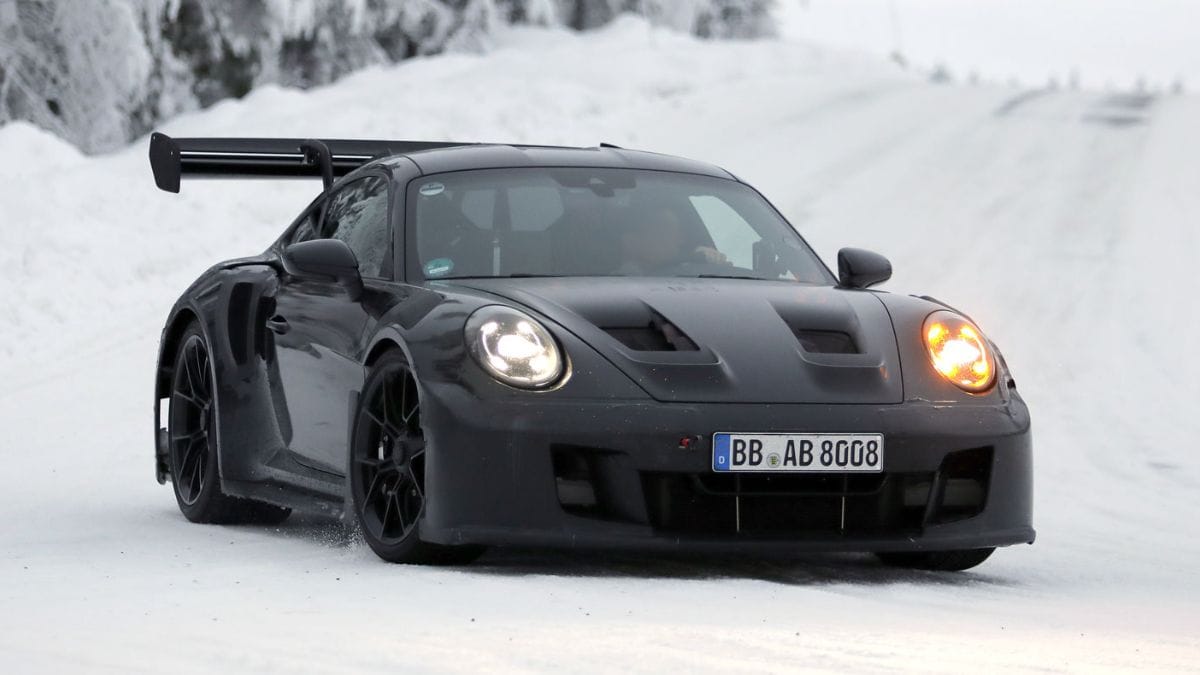
The Porsche 911 GT3 RS has been spotted undergoing testing on international roads, indicating that a facelifted version is in development. The test vehicle appeared largely undisguised, offering an early look at the updates Porsche may introduce. While the visual changes appear limited at first glance, the underlying mechanical revisions could be more significant.
This development suggests Porsche is preparing to evolve the GT3 RS in response to both performance expectations and regulatory requirements.
Design
From a design perspective, the facelifted 911 GT3 RS retains much of its existing identity. The front section shows minimal alteration, with only slight modifications visible on the front bumper. The overall silhouette and aerodynamic philosophy remain consistent with the current model.
More noticeable changes are concentrated at the rear. The updated version features four fins on either side, compared to three on the outgoing model. Although this may appear to be a minor visual adjustment, it is likely to serve a functional purpose.
Additionally, the presence of an air chamber below the tail light bar indicates further aerodynamic and cooling refinements. These updates suggest that Porsche is focusing on improving thermal management, which becomes particularly relevant if powertrain changes are introduced.
Engineering
The subtle exterior revisions point toward deeper mechanical updates beneath the surface. The enhanced cooling elements, including the additional fins and revised airflow channels, indicate that the facelifted GT3 RS may require greater thermal efficiency.
Such changes are typically associated with higher-performance powertrains. In this case, the modifications support speculation that the model could transition from its traditional naturally aspirated setup to a turbocharged configuration.
This would mark a notable shift in engineering philosophy for the GT3 RS, which has historically emphasized high-revving, naturally aspirated performance.

Powertrain
The most significant expected update concerns the engine. The current 911 GT3 RS uses a naturally aspirated flat-six engine, while turbocharging has traditionally been reserved for the more extreme 911 GT2 RS.
However, the facelifted GT3 RS may adopt a turbocharged setup, potentially combined with electrification. Reports suggest the inclusion of a 48V mild-hybrid system, which would help meet stricter Euro 7 emission standards.
Porsche has already introduced a turbo-hybrid system in the 911 Carrera GTS T-Hybrid. This setup uses a 3.6-litre flat-six engine producing 533 bhp and 570 Nm of torque. Performance figures include a 0-100 kmph time of approximately three seconds and a top speed of 312 kmph.
A similar approach could be adapted for the GT3 RS, although likely with further tuning to align with its track-focused positioning.

| Specification | Carrera GTS T-Hybrid |
|---|---|
| Engine | 3.6-litre flat-six |
| Power | 533 bhp |
| Torque | 570 Nm |
| 0-100 kmph | 3.0 seconds |
| Top Speed | 312 kmph |
Positioning
If the GT3 RS adopts a turbocharged or hybrid powertrain, it may begin to overlap more closely with the territory traditionally occupied by the GT2 RS. Porsche appears to be narrowing the distinction between these models, at least in terms of performance capabilities.
The GT2 RS is expected to move further up the performance scale, potentially featuring a 4.0-litre turbocharged engine producing around 1,000 bhp. This would maintain a hierarchy within the lineup while allowing the GT3 RS to evolve.
Such repositioning reflects broader trends in the automotive industry, where electrification and turbocharging are becoming integral even in high-performance segments.
Compliance
Another factor influencing these changes is regulatory pressure. The introduction of Euro 7 emission norms is prompting manufacturers to adopt hybrid technologies and more efficient powertrains.
By integrating a 48V mild-hybrid system, Porsche can reduce emissions while maintaining performance standards. This approach allows the brand to balance environmental requirements with its established performance identity.
Outlook
The facelifted Porsche 911 GT3 RS appears to be a measured update in terms of design, but a potentially significant one mechanically. While the exterior changes are subtle, the indications of improved cooling and possible powertrain revisions suggest a shift in direction.
If the model transitions to a turbocharged or hybrid setup, it would represent a departure from its naturally aspirated roots. At the same time, it would align the GT3 RS with evolving industry standards and technological advancements.
The final specifications and official confirmation are still awaited. However, the early test sightings provide a clear indication that Porsche is preparing a meaningful update to one of its most track-focused models.
FAQs
Is GT3 RS getting turbo?
It may receive a turbocharged engine.
What changed in design?
Minor front and revised rear fins.
Will it be hybrid?
Expected mild-hybrid system.
Why cooling upgrades?
To support higher performance engine.
Is GT3 RS still NA?
Future version may not remain NA.