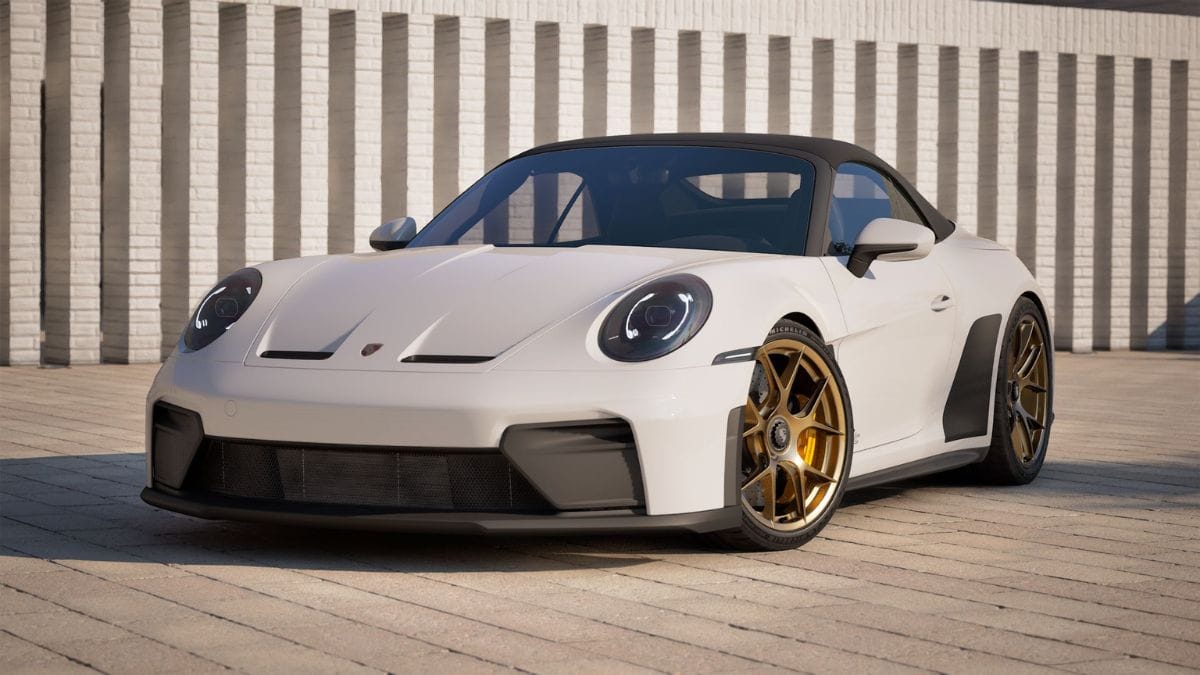
The idea of a convertible Porsche 911 GT3 may initially seem unconventional. For decades, the GT3 badge has been associated with precision engineering, aerodynamic efficiency, and track-oriented performance.
Removing the roof appears, at first glance, to challenge that identity. However, the introduction of the 911 GT3 S/C suggests a broader interpretation of what a GT3 can represent, without fully departing from its core principles.
The GT3 S/C enters the lineup as a variation rather than a replacement. Porsche has not attempted to redefine the GT3 formula entirely. Instead, it has expanded it. The S/C maintains the mechanical foundation of the standard GT3 while introducing an open-top configuration that alters the driving experience.
This approach reflects a measured shift in philosophy. Rather than focusing exclusively on lap times and circuit performance, the S/C acknowledges the value of driver engagement in varied environments, including public roads.
Engine
At the center of the GT3 S/C remains Porsche’s naturally aspirated 4.0-litre flat-six engine. This unit continues to be a defining feature of the GT3 range, known for its responsiveness and high-revving character.
The engine’s ability to reach a 9,000 rpm redline is unchanged. Equally important, the availability of a manual transmission preserves a level of driver involvement that is increasingly uncommon in modern performance cars.
| Feature | Details |
|---|---|
| Engine | 4.0L NA Flat-Six |
| Max RPM | 9,000 rpm |
| Transmission | 6-speed manual |
| Layout | Rear-engine, RWD |
From a technical standpoint, retaining these elements ensures that the S/C remains closely aligned with the GT3’s established identity.
Structure
Converting a coupe into a convertible typically introduces structural challenges. The absence of a fixed roof can reduce rigidity and require additional reinforcements, often leading to increased weight.
Porsche has addressed these concerns through targeted engineering measures. Reinforcements have been integrated to maintain chassis stiffness, while efforts have been made to limit weight gain. Although the S/C may not match the exact rigidity of the fixed-roof GT3, it remains within a range that supports precise handling and stability.
This balance is central to the car’s positioning. It is not intended to outperform the standard GT3 on a track, but it aims to deliver a comparable level of control and confidence in everyday driving conditions.
Experience
The most significant difference introduced by the S/C is experiential rather than numerical. The open-top configuration changes how the driver interacts with the car.
Without a roof, engine sound becomes more pronounced. The intake noise, exhaust note, and mechanical feedback are less filtered, creating a more direct sensory connection. This is particularly noticeable at higher engine speeds, where the flat-six engine produces its characteristic sound profile.
In practical terms, this means the S/C emphasizes engagement over isolation. While performance metrics remain important, the overall experience is shaped more by perception and feedback than by raw data.
Design
The exterior and aerodynamic elements of the GT3 S/C have been adapted to suit its configuration. While it retains key GT3 design features, adjustments have been made to account for airflow changes associated with an open cabin.
Downforce levels are likely to differ slightly compared to the coupe version, but Porsche has ensured that the car remains stable at speed. The visual identity also reflects its dual purpose – combining elements of track-focused design with the openness of a convertible.
Inside, the cabin maintains a driver-focused layout, consistent with the GT3 lineage. Controls, seating position, and materials are aligned with performance driving requirements.
Positioning
One notable aspect of the GT3 S/C is its production strategy. Unlike models such as the 911 Speedster or the 911 S/T, which are produced in limited numbers, the S/C is expected to have broader availability.
| Model | Production Type | Primary Focus |
|---|---|---|
| GT3 S/C | Open | Driving engagement |
| Speedster | Limited | Collectibility |
| 911 S/T | Limited | Heritage and rarity |
This distinction influences how the car is perceived in the market. By avoiding limited production, Porsche positions the S/C as a vehicle intended for regular use rather than long-term storage.
Context
The introduction of the GT3 S/C reflects broader trends within the automotive industry. Performance cars are increasingly expected to balance capability with usability. While track performance remains important, manufacturers are also considering how vehicles are experienced in everyday contexts.
In this sense, the S/C can be seen as part of a gradual evolution. It does not replace traditional GT3 values but complements them by offering an alternative perspective.
Consideration
For some enthusiasts, the absence of a fixed roof may still be viewed as a compromise. The GT3 has historically been defined by its focus and minimal concessions to comfort or versatility.
However, it is important to consider the intended use of the S/C. It is not positioned as a direct competitor to the standard GT3 in track conditions. Instead, it provides a different form of engagement, one that prioritizes accessibility and sensory experience.
The question is less about whether it matches the original GT3 in every metric and more about whether it fulfills a distinct purpose within the lineup.
Perspective
The Porsche 911 GT3 S/C illustrates how established performance concepts can be adapted without being entirely redefined. By retaining key mechanical components and introducing an open-top format, Porsche has created a model that broadens the scope of the GT3 range.
It may not align with every traditional expectation associated with the badge. However, it offers a version of the GT3 experience that emphasizes interaction, sound, and accessibility. For drivers who value these aspects, the S/C presents a considered and technically consistent alternative within the 911 family.
FAQs
What is the GT3 S/C?
A convertible version of the Porsche 911 GT3.
Does it use the same engine as GT3?
Yes, it keeps the 4.0L flat-six engine.
Is GT3 S/C track-focused?
It is capable, but less track-focused than GT3.
Is the GT3 S/C limited production?
No, it is expected to be widely available.
What is its main advantage?
Enhanced driving experience with open-top feel.