Apple has officially discontinued the Mac Pro, bringing an end to one of its longest-running and most recognizable product lines. First introduced in 2006, the Mac Pro served as the company’s flagship desktop computer for professionals, remaining in production for nearly twenty years. The product has now been removed from Apple’s official website, marking the conclusion of its lifecycle.
The discontinuation of the Mac Pro reflects a broader shift in Apple’s hardware strategy. Over the years, the company has moved away from modular, user-upgradable systems toward tightly integrated designs powered by its in-house silicon. While the Mac Pro once represented peak performance and flexibility, its role in Apple’s lineup had gradually diminished.
Origin
The Mac Pro was launched in 2006 as the successor to the Power Mac G5. It adopted a tower-based design that emphasized modularity, allowing users to upgrade key components such as the processor, memory, storage, and expansion cards.
This approach made it particularly suitable for professionals in fields such as video editing, 3D rendering, and music production, where customization and performance were critical.

Evolution
The original tower design of the Mac Pro remained largely consistent until 2012. During this period, Apple focused on incremental performance upgrades rather than major design changes.
In 2013, the company introduced a significantly redesigned version. This model, often referred to as the “trashcan” Mac Pro, featured a compact cylindrical design. While visually distinct, it marked a departure from the modular philosophy of earlier models.
The 2013 version limited upgradeability to memory and storage. Over time, thermal constraints in the compact chassis restricted hardware improvements, leading to stagnation in updates. Apple later acknowledged these limitations.
Redesign
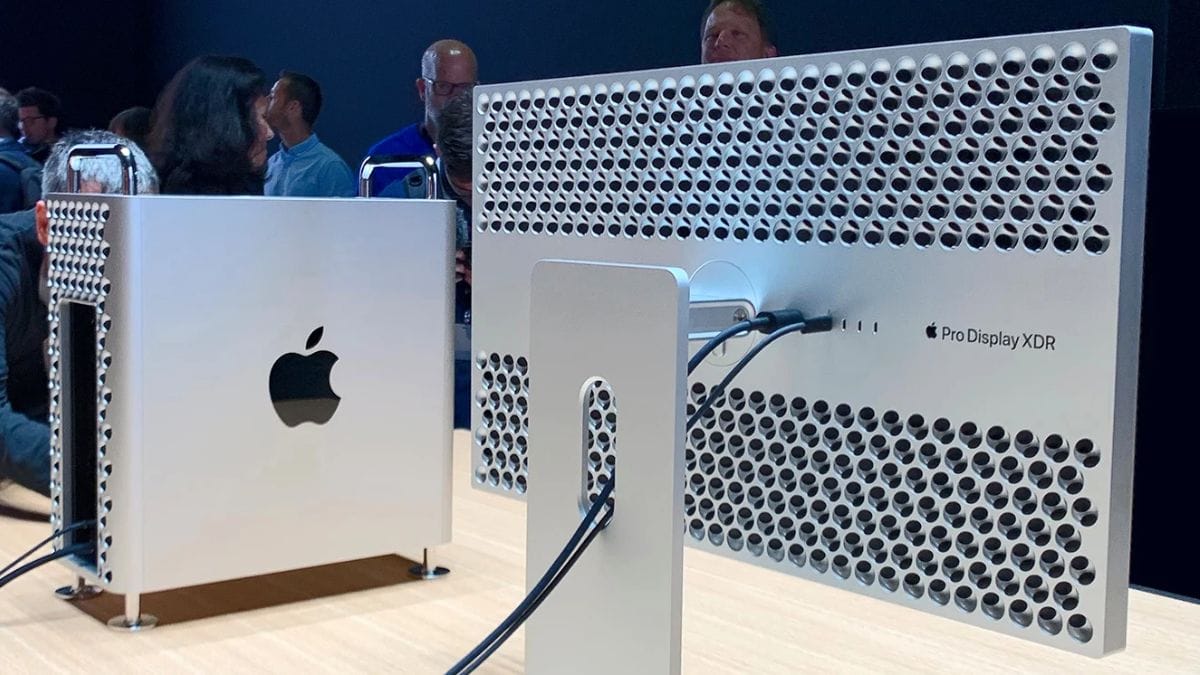
In 2019, Apple reintroduced a tower-based Mac Pro, returning to a modular design. This version allowed users to upgrade most components except the CPU, restoring some of the flexibility that professionals had valued in earlier models.

The 2019 Mac Pro was also among the last Apple computers to use Intel processors, arriving just before the company began transitioning to its own ARM-based chips.
Transition
Apple completed the transition to its in-house silicon with the introduction of the M-series chips. The Mac Pro received its final update in 2023, featuring the M2 Ultra processor.
While the external design and modular structure remained, the shift to Apple silicon limited the practical use of PCI expansion slots. Many traditional upgrades and third-party components were no longer supported in the same way as before.
This reduced the system’s appeal among users who relied on extensive hardware customization.

Competition
Over time, the Mac Studio emerged as a more practical alternative within Apple’s desktop lineup. Offering high performance in a smaller form factor, it effectively replaced the Mac Pro as the company’s most powerful desktop solution.
The Mac Pro, by comparison, became increasingly difficult to justify in terms of size, cost, and functionality.
Comparison
A brief comparison between the final Mac Pro and Mac Studio highlights the shift:
| Feature | Mac Pro (2023) | Mac Studio (M-series) |
|---|---|---|
| Design | Tower | Compact desktop |
| Chip | M2 Ultra | M-series options |
| Modularity | Limited (PCI slots) | Minimal |
| Target users | Niche professionals | Broad professional use |
| Market position | Discontinued | Current flagship |
The table reflects how Apple’s priorities have shifted toward compact, integrated systems.
Strategy
According to industry reports, Apple had been considering discontinuing the Mac Pro for some time. The product’s relevance had declined as fewer users required large, modular desktop systems.
Apple’s current design philosophy emphasizes efficiency, integration, and performance per watt. In this context, a large, upgradeable tower no longer aligns with the company’s direction.
Legacy
Despite its discontinuation, the Mac Pro remains a significant product in Apple’s history. It was widely recognized for its design, build quality, and performance capabilities.
For many users, particularly professionals, it represented a reliable and powerful workstation. Its modular approach also set it apart from most modern computing devices, which prioritize compactness over upgradeability.
The Mac Pro’s journey reflects broader changes in the personal computing industry, where flexibility has gradually given way to integration.
The discontinuation of the Mac Pro marks the end of an era for Apple’s professional desktop lineup. While its role has been overtaken by newer products like the Mac Studio, its impact on design and performance standards remains notable. As Apple continues to refine its hardware ecosystem, the Mac Pro stands as a reminder of a different approach to computing, one centered on customization and expansion.
FAQs
When was the Mac Pro first launched?
It was launched in 2006.
Why was the Mac Pro discontinued?
It lost relevance in Apple’s current lineup.
What replaced the Mac Pro?
Mac Studio is now the flagship desktop.
What was the last Mac Pro model?
The 2023 model with M2 Ultra chip.
Was Mac Pro upgradeable?
Yes, earlier models were highly modular.